Evaluating CRISPR tools in zebrafish

Our recent paper “Evaluation of CRISPR gene-editing tools in zebrafish” led by grad student José Uribe-Salazar is out in BMC Genomics. Several others from the lab contributed including lab manager Gulhan Kaya, volunteer Aadithya Sekar, and postbacs/undergrads KaeChandra Weyenberg and Cole Ingamells.

Some highlights:

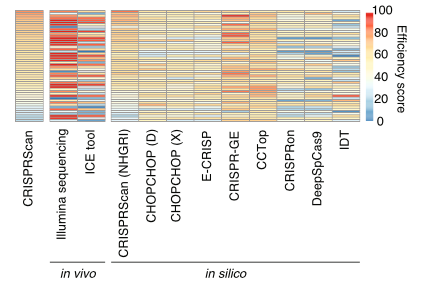
  • We tested editing accuracy and predictability of 50 guide RNAs (from IDT) with SpCas9 using in vivo, in silico, and in vitro methods.

  • Large discrepancies existed between in silico editing predictive tools and empirical in vivo cutting efficiencies. The most accurate prediction resulted from using CRISPRScan against a reference specific to our zebrafish strain.

  • We observed low frequency of off-target mutations with no method (in silico or in vitro) effectively predicting these. More analyses are needed to understand the variability involved in off-target cutting events.

  • To characterize commonly-used controls in zebrafish CRISPR experiments, we evaluated larvae solely injected with SpCas9 (enzyme or mRNA) and found no evidence of an excess of somatic mutations in these injected larvae.

  • Performing RNA-seq of injection controls revealed notable variability in gene expression profiles compared to uninjected controls, including genes involved in several metabolic pathways that highlight a potential lasting effect of the microinjection. We recommend caution if performing characterizations of these particular genes in mosaic crispants.

Overall, our hope is for this resource to be helpful for the zebrafish/CRISPR community while they plan their future awesome experiments!

RapID semi-automated cell counter

Our recent paper “RapID Cell Counter: Semi-automated and mid-throughput estimation of cell density within diverse cortical layers” was published in eNeuro co-led by IGG grad students Aarthi Sekar and Thiago Sanches and in collaboration with the amazing Simó lab at UC Davis. After struggling to manually count neurons from images of in utero electroporation of mouse neocortex, we decided to make an easy-to-use automated tool that can quantify fluorescently-labeled cells across defined layers. The method is called RapID and is available here.

Some highlights of our study:

  • RapID runs as an easy-to-use GUI, with step-by-step instructions on how to install and run as supplementary materials and on the Github. Our hope is that the tool will be useful to the community with install and implementation representing only a small hurdle. Please reach out to us if you encounter difficulties!

  • Users define parameters for images based on expected cell size, density, and brightness. RapID subsequently will quantify labeled cells within a user-defined quadrangle (split by set number of layers). Parameters used for diverse cell types by our groups are included in the study as a starting point for users.

  • We successfully show that RapID results match manual “click” identification using Fiji’s Cell Counter and apply it to diverse cell images, including astrocytes and dopaminergic neurons.

As an added bonus: the beautiful images of dopaminergic neurons, made by the talented Keiko Hino and Sergi Simó, were selected as an official Zoom backdrop for the Society for Neuroscience available for download on their website!

Three of our former undergrads heading to grad school

We are so proud of former Dennis lab undergrads heading off to grad school this fall!

KindheartedMasculineEel-max-1mb.gif
  • Matangi Kumar will be starting in the Vision Science Ph.D. program at UC Berkeley. She also received a UC Davis Distinguished Scholar award as one of the top Genetics and Genomics undergrads in her graduating class!

  • Mira Mastoras is joining the Biomolecular Engineering and Bioinformatics Ph.D. program at UC Santa Cruz.

  • Eva Ferino was accepted to the Genetic Counseling master’s program at UCSF.

Regulatory mechanisms of recent human gene duplications

Our recent study “Diverse Molecular Mechanisms Contribute to Differential Expression of Human Duplicated Genes” was published in Molecular Biology and Evolution led by IGG grad student Colin Shew, with support from various current/former Dennis lab members Paulina Carmona-Mora, Daniela Soto, Mira Mastoras, Elizabeth Roberts, Joseph Rosas, and Gulhan Kaya and collaborator Henriette O’Geen. Using diverse functional genomic datasets, we characterized expression of recent human gene duplicates to better understand their functional fates and mechanisms underlying altered paralog expression.

Screen Shot 2021-08-06 at 3.30.57 PM.png

Major highlights of the study:

  • Most human derived duplicate genes diverge in expression from their human and chimp counterparts, suggesting they’re undergoing neofunctionalization or pseudogenization.

  • In some cases derived genes may have usurped function of their ancestral paralogs or function through increased gene dosage.

  • Evolutionary age, post-transcriptional mechanisms, copy-number, and truncation status cannot completely explain observed diverged expression of genes in lymphoblastoid cell lines

  • ChIP-seq datasets miss most histone marks in duplicated regions that we recover using a modified bioinformatic pipeline that allows multiple read mappings.

  • We did not detect global differences in regulatory signatures between ancestral and derived paralogs, but rather, individual differences in cis regulatory elements, which we validate using reporter assays.

High-throughput zebrafish phenotyping platform

Tha lab’s first zebrafish paper “Assessment of Autism Zebrafish Mutant Models Using a High-Throughput Larval Phenotyping Platform” was published in a special topic of Frontiers in Cell and Developmental Biology: Zebrafish Models for Human Disease Studies led by postdoc Alexandra Colón-Rodríguez with support from present and former Dennis lab members José Uribe Salazar, KaeChandra Weyenberg, Aditya Sriram, Alejandra Quezada, Gulhan Kaya, Emily Jao, and Brittany Radke, as well as collaborator Pam Lein. Amazingly, co-authors included three undergrads and a high school student!

Some highlights:

  • Tested impacts on larval development of a high-throughput platform allowing morphological measurements using the VAST imaging system coupled with motion-tracking using DanioVision to detect drug-induced seizures.

  • Identified developmental defects (altered brain and eye sizes) and enhanced seizures for CRISPR mutants targeting orthologs of autism genes, SYNGAP1 and SLC7A5.

  • Established defects could be detected in both mosaic and stable mutant lines, opening up the possibility to increase throughput of genes screened.

Figure3 copy.png

Farewell to team members KaeChandra, Aditya, and Elizabeth and updates

anigif_enhanced-buzz-31994-1359473038-6.gif

The Dennis lab wants to congratulate junior specialist KaeChandra Weyenberg as she departs to pursue her master’s degree in Public Health from East Tennessee University.

We are also happy to send off graduating undergrads Aditya Sriram and Elizabeth Roberts. Aditya is headed to the University of Washington to pursue a master’s degree in Epidemiology and Elizabeth will pursue research at the Broad Institute in the Lander lab as she prepares to apply to grad school in the future.

We are also celebrating the news of several former Dennis lab undergrads:

  • Maram Bader has accepted an offer of admission to San Jose State University’s master’s in Microbiology and Molecular Biology program.

  • Dhriti Jagannathan plans to join the Genetic Counseling master’s program at the University of Minnesota.

  • Juliann Wang will start medical school at the University of Alabama at Birmingham School of Medicine.

2020 TAGC virtual conference

Third year IGG grad student José Uribe Salazar and PI Megan represented the Dennis lab at The Allied Genetic Conference (TAGC) this past week, showcasing two zebrafish projects ongoing in the group. José presented in the Zebrafish Neurogenetics session on a human-duplicated SRGAP2 zebrafish model and Megan presented in the Zebrafish Technologies session on a parallel-phenotyping platform to screen for multiple neurodevelopmental features in larvae. Talks were recorded and available (with conference registration) until mid-May via the TAGC website.

20200422_140917.jpg

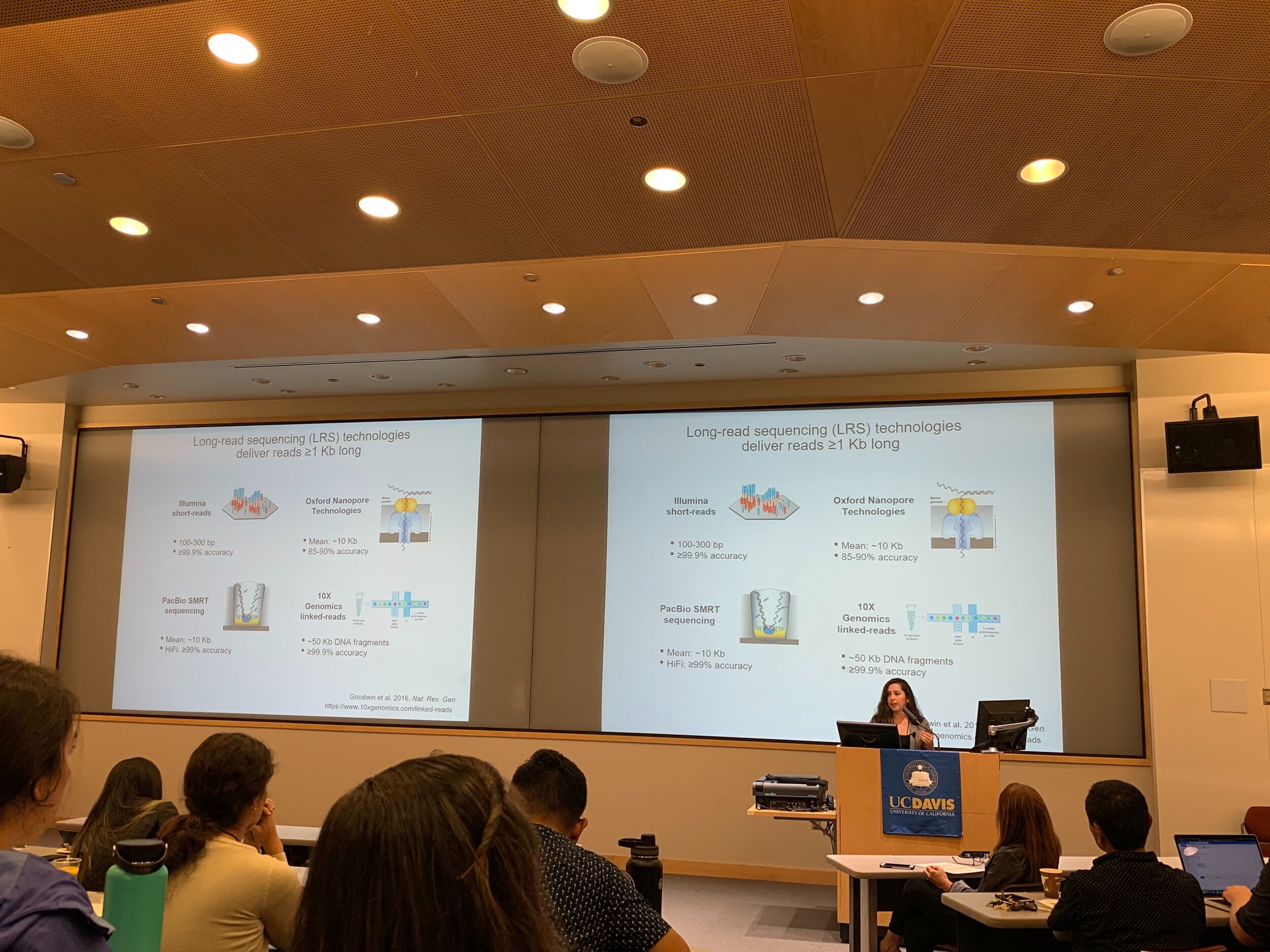
Structural variant discovery in chimpanzees using long-read sequencing

The Dennis lab has published its first lead-authored paper “Identification of Structural Variation in Chimpanzees Using Optical Mapping and Nanopore Sequencing” in a special issue of Genes: A Tale of Genes and Genomes, led by IGG PhD students Daniela Soto and Colin Shew with support from lab members, including research specialists Mira Mastoras and Gulhan Kaya, the UC Davis Genome Center core (Ruta Sahasrabudhe), as well as collaborator Aida Andrés and her group.

Some highlights:

  • Identified deletions and inversions (SVs) in two chimpanzees vs. a human reference using nanopore and optical mapping, including 88 novel deletions and 36 novel inversions.

  • Coupled with RNA-seq and Hi-C data from LCLs and IPSCs, we found SVs to be enriched for differentially-expressed genes between human and chimpanzee and depleted for TAD boundaries, recapitulating work from others.

  • Generated TAD maps directly comparing human and chimpanzee that show how inversions and deletion can perturb the chromatin landscape.

  • Highlighted genes found impacted uniquely in chimpanzees, that may play a role in species-specific traits (including some exhibiting signature of positive/balancing selection).

  • This represents the first nanopore sequencing of a chimpanzee (a western female) and, importantly, all our data is available for download (Illumina, ONT, bionano, and Hi-C) on our github page here.

ESSeZF-U8AA4BHE.png

UC Davis Human Genomics symposium

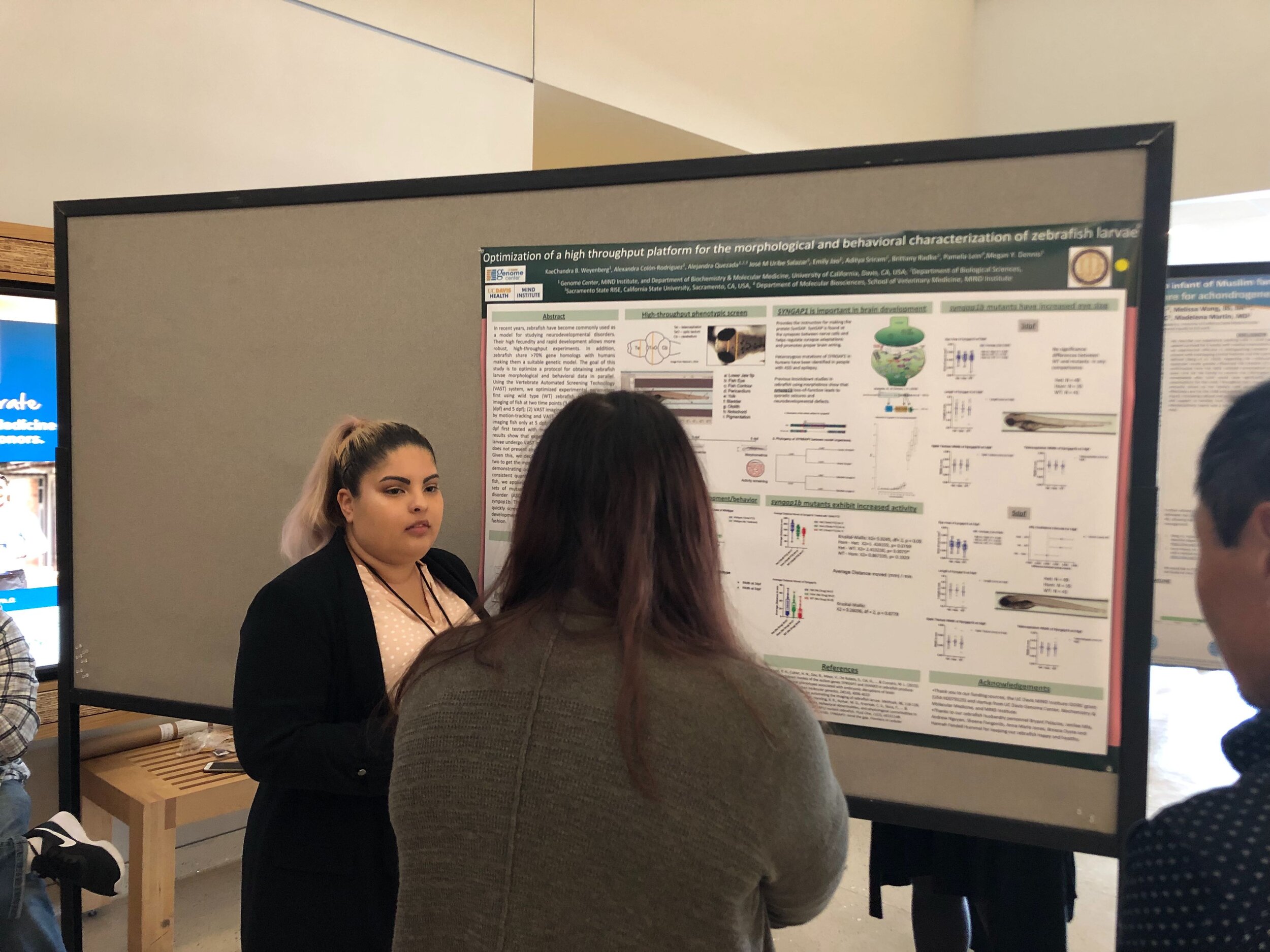
Congratulations to junior research specialist KaeChandra Weyenberg for winning a poster award at the UC Davis Human Genomics symposium on her work using zebrafish to characterize genes important in neurodevelopmental disorders (her first ever presented research poster!).

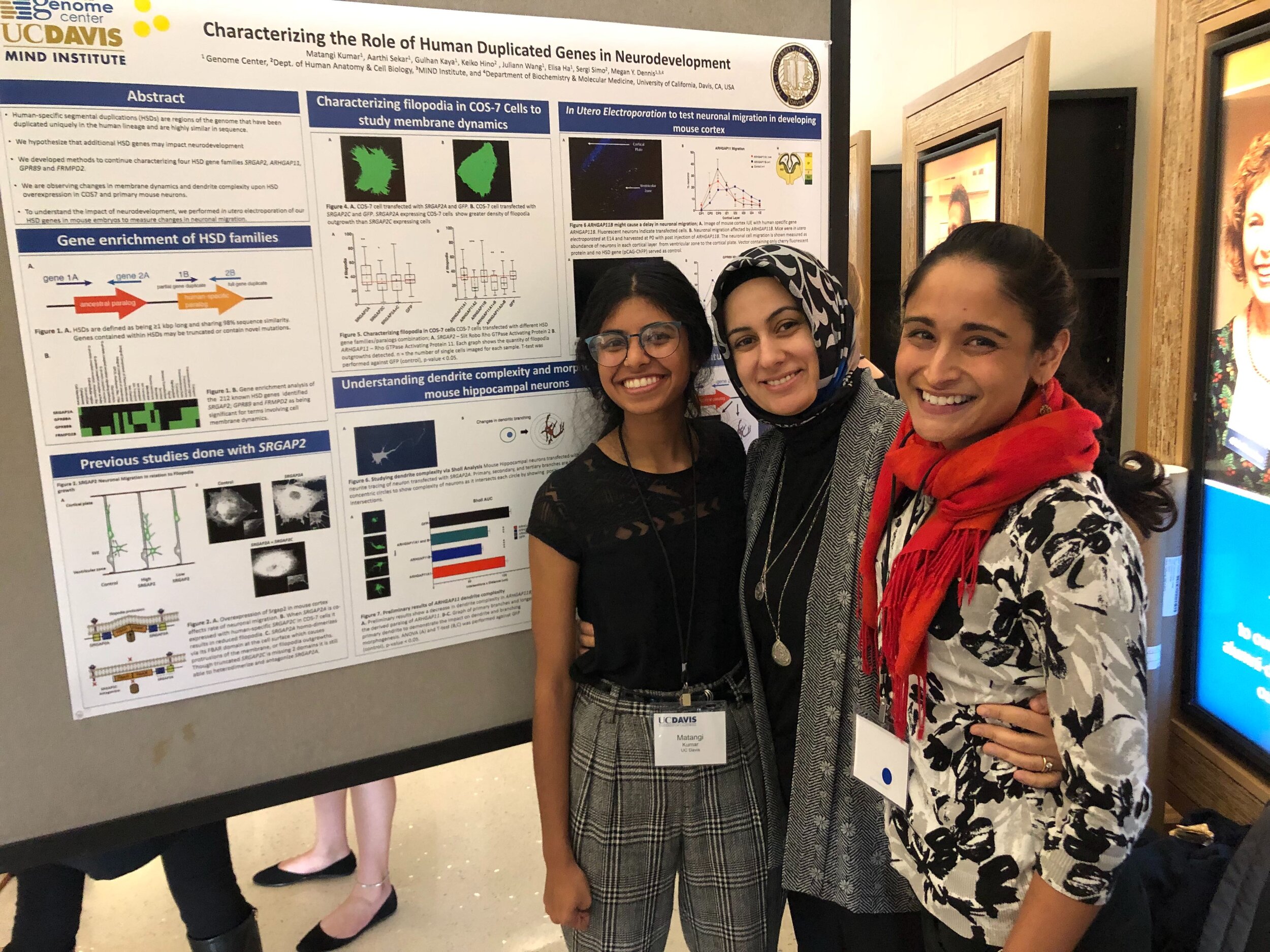
Also, the Dennis lab was represented by excellent presentations from additional lab members, including grad student Daniela Soto and undergrad Matangi Kumar. It was a fun, information-packed day full of impressive human genomic research ongoing at UC Davis!